
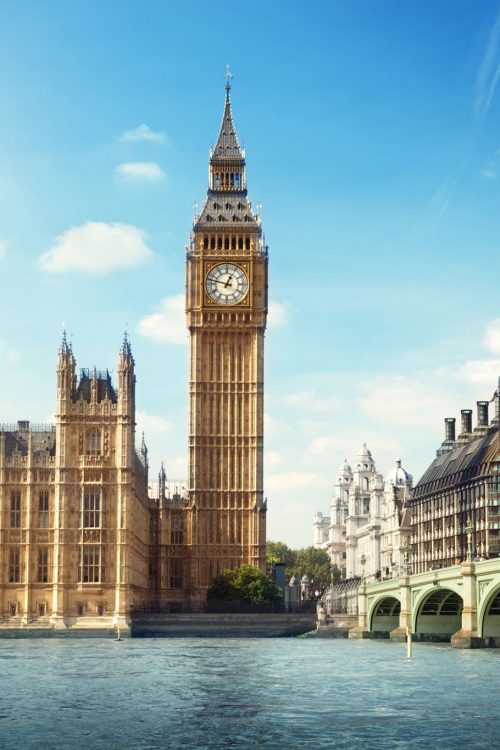
Big Ben is the nickname for the Great Bell of the striking clock at the north end of the Palace of Westminster in London and is usually extended to refer to both the clock and the clock tower. The official name of the tower in which Big Ben is located was originally the Clock Tower, but it was renamed Elizabeth Tower in 2012 to mark the Diamond Jubilee of Elizabeth II. The tower was designed by Augustus Pugin in a neo-Gothic style. When completed in 1859, its clock was the largest and most accurate four-faced striking and chiming clock in the world. The tower stands 315 feet tall, and the climb from ground level to the belfry is 334 steps. Its base is square, measuring 39 feet on each side. Dials of the clock are 23 feet in diameter. On 31 May 2009, celebrations were held to mark the tower’s 150th anniversary. Big Ben is the largest of the tower’s five bells and weighs 13.5 long tons. It was the largest bell in the United Kingdom for 23 years. The origin of the bell’s nickname is open to question; it may be named after Sir Benjamin Hall, who oversaw its installation, or heavyweight boxing champion Benjamin Caunt.

